Overview
What KnocScore is, the problem it solves, and the terms used throughout this wiki.
Last Updated: October 17, 2026
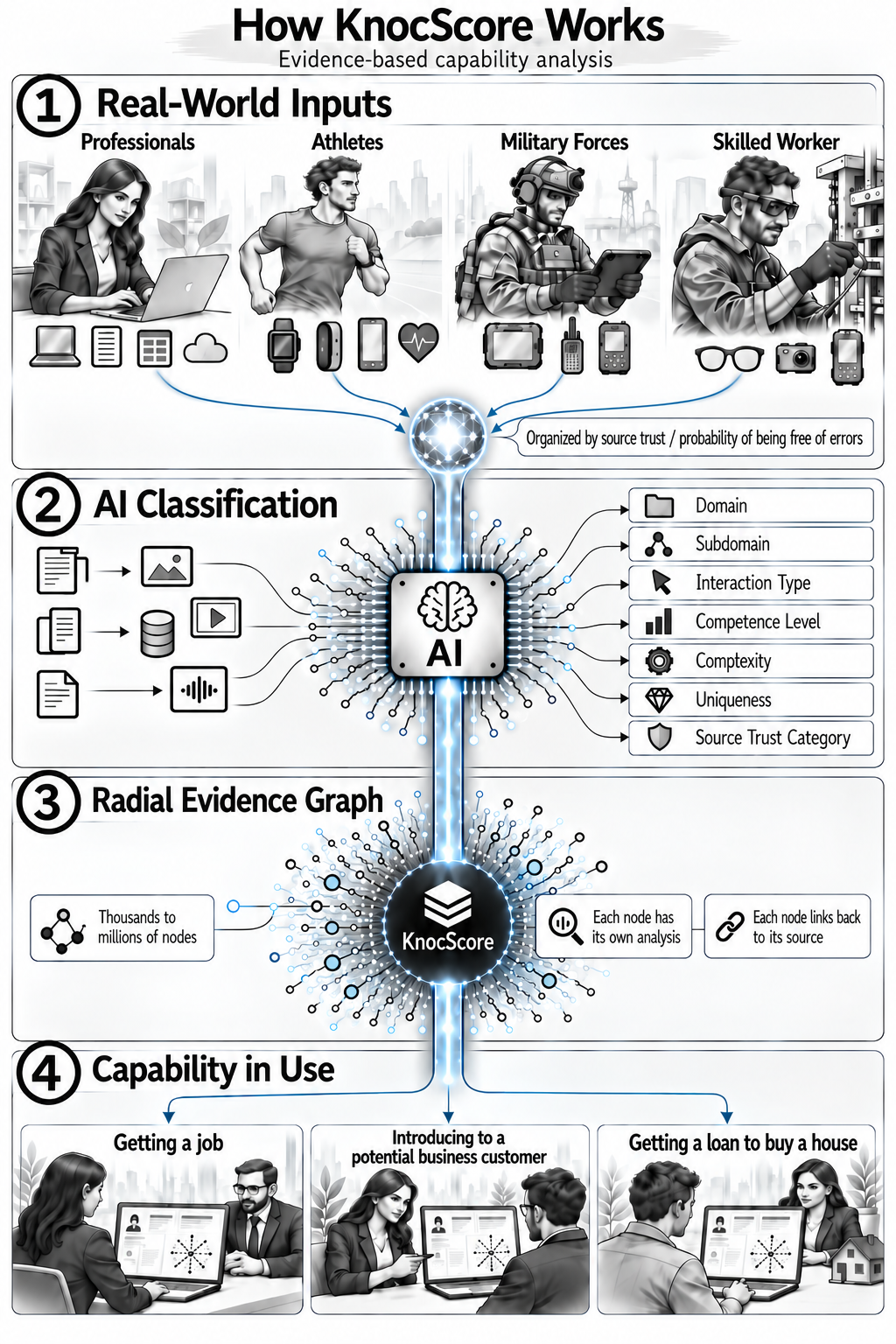
1. How KnocScore Works Infographic
Think of KnocScore as a historian. Experience leaves a trail. But until now there has been nothing that would prove where that trail had been, or what someone who built it could do.
KnocScore changes this.
2. What KnocScore Is
The world is filled with claims of expertise, but little credibility to support them. Credentials, resumes, and professional profiles tell others what people claim to know, while valuable evidence of actual capabilities remains scattered, largely unrecognized, and difficult to verify. This creates uncertainty in business relationships, hiring, and decisions where competence matters.
KnocScore turns everyday interactions into evidence of expertise. From thousands to millions of particles, contributions are analyzed for competence, complexity, and uniqueness.
KnocScore's platform converts discussion, creation, practice, and study into a Knowledge Credibility Metric — a multi-dimensional and multi-source measure of activity rated by selectable levels of trust. Instead of relying on users to self-report their skills, applications contribute evidence particles that confirm capabilities and thus removing biases, errors, and doubt.
Evidence from connected applications are combined into a single portable profile the end user owns. Application, Software, and in the future, hardware can be identified as connected by displaying a Contributor Symbol that signals to users that their contributions count towards a future they've built.
The KnocScore, despite it's name, is not a score. It is an unbiased, unopinionated, display of evidence based on it's source trust. It shows duration of interactions or time in hours within a domain/field of knowledge and how that interaction occurred. It shows when the activity occurred with a start time and an end time. Interactions are broken down into discussion, creation, practice, and study. Study is segmented into free recall and prompted interactions. Each particle is auditable to its source. The analysis provides why it selected the domain, level of complexity, uniqueness, and competence. This allows the observer-user to form their own independent opinion. Interactions will also show, where possible, if other people were involved.
Trust Is Important. A source of an evidence particle is not granted trust automatically. Trust is a rating based on the probability of correctness. Evidence is divided into Concrete and Non-Concrete categories. Non-Concrete evidence is divided into further categories based on source reliability, transparency, accountability, and the consequences of inaccuracies. These ratings may change over time but are generally divided into the following categories:
| Category of Trust | Definition |
|---|---|
| Category I: Concrete Evidence | The interactions are known to be conducted by the individual because both the interactions and the individual are directly observed and their participation is verified. Live applications that capture interactions and provide evidence that they were conducted by the individual, rather than AI or another person, fall into this category. Video chat may qualify. This may also include engagement with AI where the individual is observed in a live setting, text or code editing software where the individual's activity is observed and analyzed, or domain-specific software or hardware where verified operation provides evidence of expertise. |
| Category II: Structural guarantee with high Reputational or Economic Exposure | A very low probability of errors, supported by substantial accountability and independent oversight. The interactions conducted by the individual are not directly observed but are supported by records maintained in a repository. Accountability is high for both the repository and the individual. Inaccuracies, misrepresentation, or misconduct carry meaningful economic, legal, or reputational consequences. Oversight is structurally independent of the parties involved, responsibilities are separated, and accountability is demonstrated through verifiable examples of enforcement. Errors or misconduct must be subject to meaningful scrutiny and consequences. As an example, documents maintained by an entity may qualify if the relevant procedures satisfy these conditions. Institutional authority alone does not establish Category II trust. Examples are patents maintained by the USPTO or EPO. |
| Category III: Limited structural guarantee, limited transparency, infrequent reputational loss | Infrequent probability of errors supported by a high reputational cost. There may be substantial reputational or economic gains from the information, but transparency and independent, structurally unbiased oversight are limited to a small set. Oversight may be conducted by peers from separate organizations that traditionally hold one another accountable. However, independence and enforcement may be difficult to establish. Due to the subject matter, legal restrictions, or complexity, the underlying evidence of an individuals interactions, and review process may be accessible to only a few observers. Academic publications are examples where institutional history is inconsistent with its representation, particularly where the underlying research is not independently examined or reproduced and domain authority is difficult to question. |
| Category IV: Reported by a Third Party with Limited Reputational or Economic Exposure | There may be moderate reputational or economic consequences for inaccuracies, but evidence to confirm or refute a claim is difficult to establish. The consequences of misrepresentation or error, if discovered, may exceed the potential gain. However, the probability of discovery is low, and there are few demonstrated examples of accountability or enforcement. Structural accountability may exist but is rarely exercised. Oversight, methods, or supporting evidence may lack transparency or independent verification. Examples include performance reports from supervisors, professional recommendations, institutional grades, and traffic-camera assessments where the underlying methods, equipment, calibration, or implementation cannot be independently verified. |
| Category V: Weak Sources of Information | There is little to no economic or reputational cost for inaccuracies, and claims are difficult to verify independently. Examples include social media, résumés, and other self-reported claims of experience or expertise. |
Keys to these categories are that the ratings are based on independent oversight, transparency, demonstrable accountability, and meaningful consequences for inaccuracies.
An institution's reputation, authority, or published procedures do not establish trust. The relevant considerations are whether errors can be discovered, whether oversight is genuinely independent, and whether those responsible face credible economic, legal, or reputational consequences.
This approach is compatible with philosophical research on testimonial reliability and research on verification incentives. It also preserves the distinction between a claim and the reliability of the evidence supporting it.
3. Glossary
| Term | Meaning |
|---|---|
| Application | A single integration registered on KnocScore — your website, app, or platform. |
| App Owner | The developer or company account that registers and manages an Application. |
| App-UUID & Secret | The credentials an Application uses to authenticate requests to KnocScore. See Quick Start. |
| Corpus | The piece of text or activity submitted for analysis during a given session. |
| Contributor Symbol | The badge your application displays to signal that a user's contributions are measured by KnocScore. |
| Public Application Connection Page | The public facing webpage that provides: 1. a description of an application and 2. confirms it is accepted and connected. This confirms that an application may contribute to an end users knowledge credibility metrics. |
| Application Owner Dashboard | The application owner/administrator tool on KnocScore where user's can build their application description. |
| End User | The person using your Application whose activity is analyzed and credited. |
| Observer User | The person who observes the data about the end user. |
| Nodes, sub-nodes, child-nodes, parent-nodes, and the root-node | Nodes, in the context of the KnocScore Knowledge Graph represent a field or sub-field of expertise/domain of knowledge. The "root-node" is the center node and represents the Top Level Domain. Sub-nodes and child-nodes are essentially the same. They have parent nodes, and a sub-or child node may have several more child nodes that extend several levels outward from it or it may have none. Every child node in a knowledge graph has at least one parent. |
4. Is KnocScore Right for me?
KnocScore is for you if you do real work inside the apps, platforms, or tools you already use — and you'd like that effort to count for something beyond the app itself. Instead of asking you to prove yourself all over again on a new resume, profile, or portfolio, KnocScore builds a portable, credible record directly from the activity you're already producing.
- You regularly produce real, analyzable work — writing, code, forum answers, course exercises, support responses, and similar activity — where the content itself is the focus of the interaction.
- You perform specific tasks tied to a profession or field where there may not be content to analyze, but consistent, proper practice is itself the measure of skill.
- You fall somewhere in between, like law or news reporting, where the practice is the activity being measured rather than any single piece of content.
If any of that sounds like you, KnocScore turns effort that would otherwise be invisible or hard to verify into a credible record you control — one that travels with you across the applications that you choose to connect.
Not sure if you fit one of these categories? Reach out through Support & Compliance and we'll help you figure it out.
5. Is KnocScore Right for My App | Device | or Software?
KnocScore fits applications in three categories.
- The first is where users regularly produce real, analyzable work — writing, code, forum answers, course exercises, support responses, and similar activity. The content is the focus of the interaction.
- The second is where interactions are specific tasks that are related to a proffession or field. There may not be content to analyze but its proper use is practicing the art of the field.
- The third is a hybrid, like law or news reporting where the practice is the activity, not the content.
Most user effort is invisible or hard to verify. By connecting to KnocScore, you give your users a portable, credible record. This gives your app a trust signal in return.
If your application doesn't fit into these catagories, KnocScore may not be a fit yet — reach out through Support & Compliance if you're unsure.
6. Next Steps
To start earning the future you make: Sign up
To connect your app, software, or device: Register your app and use Quick start to learn how to get started and send your first test.
Agreements
Third-Party Application Integration Agreement An API Use Agreement for KnocScore Services.